Showing posts with label community engagement. Show all posts

Wednesday, 27 January 2016

Library task force: "community libraries" toolkit

I can't say that I'm impressed with the notion of replacing public libraries with "community libraries," especially not when the engagement with the community is at the end of an Austerity shotgun.

That being said, one of the jobs to be done by the Library Task Force is a review of the process and the building of guidance — for and against the idea — for those thinking of embarking on the adventure. And they're inviting contributions to this toolkit.

This is the contribution I've added to the discussion:

I think we need to address the brief you've been given, not least because it gives the opportunity to explore some of the practical issues involved in taking public libraries out of the public sector and why there are real fears about it. 
Firstly, a strategic issue: review after review (and Sieghert was no exception) has noted that part of the problem with the public library service is its fragmented nature. That, together with the fact that nigh on everything in English public library land is optional, means that there's little strategic development; limited opportunity for significant economies of scale outside book-buying consortia; and nationwide initiatives depend for their critical mass on a postcode lottery of acceptance. Other important national failures are an absence of KPIs and no definitive asset register — the debates on the future of public libraries have no benchmarking to work from; no consistent trends data; no nation-wide evidence-based analysis of outcomes; and not only do we not have an empirical national picture of what the public library service is and how it's doing, we don't even know how many public libraries there are in England! (by way of contrast, I chose Moldova at random and found the answer in three clicks). Further fragmenting the service to a hyperlocal extent pretty much puts paid to any hopes that any of this could be corrected. 
Secondly, *whose* community? The idea of a single, close-knit, easily-identifiable community sits well with Camberwick Green but is meaningless in dormitory suburbs and mosaic inner cities. Back in Browne Issue days when demographic data was hard to come by it was horribly easy for some public libraries to become by ladies of a certain age for ladies of a certain age. Decades of work dedicated to building the culture that "public libraries are for everybody, not just people like us" risk being a waste of time and effort. How can equality impact assessments be made? How can they be made consistently? If made, what would be done with them? 
How accountable can the organisations running the community libraries be, and to whom? Whatever the shortcomings of elected members at least they can be voted out and are accountable to standards authorities. The model of imposition of community management doesn't allow for the organic growth of management and accountability structures. Grassroots voluntary activity works well when it grows from the ground up, it seldom prospers by parachute implementation and recruitment at bayonet point. 
Who owns the library data? There are intellectual property rights issues regarding the catalogue data. There are information governance issues, particularly data protection issues, regarding the customer data, loans data, the use of online resources and browsing histories within the library. Who are the Information Asset Owners? What are the information risk plans? Where are the data sharing plans? Who's going to be there to stop that person who thinks it would be a jolly good idea to collect all the names and addresses of library users and sell them to junk mail foundries to earn a few bob? 
The culture industry is one of the UK's big earners. A lot of small-scale, small-budget operations won't each have the critical mass needed to be able to afford both enough popular topics and best-sellers required for the bread-and-butter market and also a representative range of niche topics, new authors, locally-relevant stock and experimental guesses at The Next Big Thing. This will be a huge loss of seed-funding to the industry and a huge diminution of opportunity to the communities involved. One of the key drivers of human development is serendipitous discovery; if all that remains to be discovered is what is already known then there'll be a withering effect in both use and effectiveness of these services. 
That's my starter before bedtime. I hope more people add to the discussion.There's plenty more left for somebody to go at.

Saturday, 6 June 2015

As one door closes...

Lostock Library is having a tea party to mark its closing
I may have visited my local library for the last time today.

In a couple of weeks' time it will have closed as a public library. The news isn't all entirely bleak: the school that hosts the library and the local housing trust have both recognised the importance of libraries to the community and have stepped in to try and rescue at least some part of the service. So the library will reopen as a "community library" staffed by volunteers with support from the school librarian. It's great that they've recognised the need (and a measure of the way these types of organisations have changed and expanded their remit over the years) and I wish everyone involved the best of luck but I worry about its sustainability, especially with a prolonged period of the austerity experiment stretching out ahead of us.

This sort of thing is happening all over the country: unprecedented cuts in local authority budgets are leading to unprecedented cuts in services. Westminster government's cuts in public sector funding have hit local authorities disproportionately and within each authority the burden of cuts has affected some services more badly than others.Some areas — support for schools, child care services, adult care services and public health services — are ring-fenced by central government decree so receive some degree of protection (but only some degree of protection); the remainder, including statutory services like libraries, have to do as best can with their share of the meagre scraps remaining. And it will get worse as there are fewer and fewer options left for responding to each fresh demand for required savings.

It's easy to say that library managers should do this, that or the other. In some cases this may still be the case. In the past, certainly, a generation of library managers revelled, almost to a masochistic degree, in the challenge of demonstrating that it was business as usual no matter how their budgets were chipped away. Those days are long since gone and are already almost a fading memory. It's much tougher now and there is scant wriggle room or scope for creative budgeting for library managers to be able to present business as usual. And in some cases it's downright impossible…

I hadn't realised it was 15 years since Lostock Library was moved out of its own purpose-built little building next to the bus stop and shunted into a small room in the corner of the school next door. I'm a middle-aged male with no children so I have views about shifting libraries into venues that tend to exclude a significant minority of public library users. And my experience of libraries' moving into schools has been that they tend to become a really useful resource for the school and rather less so for the local adult population. Still, we were better off than some: during the post-millennial boom where many councils, including the one I still work for, were investing in their libraries Trafford Council were making cuts. Two libraries were closed and replaced by what were, in effect, deposit libraries in corners of leisure centres. Ironically, these leisure centres are now also both at serious risk of the chop to save money. When last year, after more than a decade of cuts and hollowings-out, the library service was faced with a cut of one third of its budget it would have been impossible for the service's managers to deliver the existing service and, to be fair to them, they didn't pretend to anyone that it was possible. It was no great surprise when the cuts proposals were made public: the writing was already on the wall for Lostock when the opening hours were changed so that as children were coming out of school the library closed its doors. I went to one of the public consultations about the closure and for all that members of the public complained about the unacceptability of what was being proposed they were under no illusions about the impact of a cut of this magnitude on a service that was already down to the bone. When, at half-past the eleventh hour, the school stepped up to the plate to offer to take over it was seen as a lifeline. It can't be a like-for-like replacement and staff will still be losing their jobs and that is awful but the thinking is that it's not a complete loss and it may be a way of keeping the patient alive until times change and some sort of rescue becomes possible. On the flip side, there'll be a building with the word "Library" on it and the doors will be open sometime so some politicians could present that as being business as usual. It's the community-level version of the prisoner's dilemma and it's being played out nationwide.

I may not be able to be a customer of the new library in any case: the school's closed on Saturdays and it's only odd times like my being on leave today when I could visit during the weekday opening times. I could be wrong: there may be other options in the pipeline that allow more convenient opening hours, I don't know. But in any case, fifty years after my first visit it's almost certainly the last time I'll have visited Lostock's public library.

Sunday, 3 August 2014

Net neutrality: why worry?

Net neutrality is a topic creating quite a lot of heat at the moment, due to the U.S. Federal Communications Commission's taking a look at the topic and scaring people silly in the process with the implication that there'd be the development of a two-tiered internet with them as can pay going down the line at a premium rate and the rest crawling along as best can. (CNET provides as good a summary as any.)

So what? It's a fuss in a foreign land, isn't it?

Sadly not. It'll affect us however much we may imagine or hope that it wouldn't.

So what would be the effect and why should we care?

The way I see it, the nearest practical model for how the post-net neutrality world would look is cable television. Back in the day when cable TV first came out it was full of all sorts of community engagement. There were local and hyperlocal channels; there was space for the esoteric, the informative and the downright baffling. Much of it was done on the cheap and looked it.Then there were years of consolidation and corporate buyings-up and now I could watch NCIS and CSI: Miami simultaneously on six different channels; or endless hours watching folks in nowhere towns somewhere in America shouting at each other for no apparent reason; an interminable churn of mid-Atlantic reality wannabees being vile to one another; and a carousel of Westminster Village news feeds. None of it is local. All of it is peddling the same corporate narrative. News or features about anything within a hundred miles of where I live is limited to the local half-hour news programmes on weekdays and the ten minutes where the skateboarding ducks used to be after the weekend news.

I quite liked the Internet when it was like the Wild West. We can't go back to those days but that doesn't mean it has to become just another adjumct to the Wall Street Journal.

Sunday, 6 April 2014

The latest DCMS review

I admit it, I missed the boat. By a long chalk. And so I didn't submit my views to the latest public consultation on public libraries. A combination of too many ideas, too little time and self-discipline and worrying overly-much as to how I'd make any of it fit to the three questions asked by the commissioned group.

I've no illusions that I would have made a ha'penny's difference but here are my workings out, in case anyone can use any of it:
At the outset I would like to wish you the best of luck with this latest review of the public library service in England and the hope that whatever your conclusions they are operationally practicable and support at least a decent-quality library service for our communities. You start with a serious handicap: DCMS announcements of reviews of the English public library service are a seasonal thing like the first cuckoo of Spring or the first M&S advert of Christmas. Each comes and goes and together their total operational impact in the real world has been the square root of jack all. This appalling legacy is going to colour too many of the views you are likely to hear. Including mine, unfortunately. I would love it if you could confound my cynicism.
  • There is a crying need for national leadership.
    • Now the Olympic Games are over and done with, what is DCMS for? Over the past decade — aside from the occasional launch of an enquiry into the public library service — the department’s engagement with the service has been not so much arm’s length as running a mile from.
    • The public library service in England is undefined, at best weakly supported and subject to no performance management.
    • Regulatory guidance on the delivery of the service is virtually non-existent.
    • The potential for improving the efficiency and effectiveness of the public library service by pooling resources and delivery channels across local geopolitical boundaries is being driven patchily at the local level at the same time as long-standing sharing mechanisms are being abandoned or left to wither on the vine.
    • The English public library service is not an integral part of a national literacy programme, a national digital literacy programme or a national information literacy programme despite the huge amount of good work being locally done in these areas by many, if not most library authorities.
      • DCMS is not demonstrating that it knows or much cares about:
        • How many public library buildings are currently still in use;
        • What other delivery channels are being made available for library services;
        • What services are being delivered by these delivery channels;
        • Whether or not these services adequately reflect the needs of the communities they serve;
        • What resources should be employed to provide these services.
  • Nobody knows what the public library service is. Everybody has an opinion, nobody has an empirical measure and there is no bottom-line base level of service that can be expected nationwide.
    • The sad fig-leaf that is the 1964 Act provides a fine-sounding but practically-useless sound bite. The sole practical impact of the Act is that public libraries used to get listed under “Statutory” rather than “Discretionary” when the auditors came round to see how well the local council was doing.
    • There is a view that if a building has had the word “library” stuck on it some time in its lifetime and the doors are still open then all is well in the world.
    • There is another view that so long as a building is open to the public and has some books for loan that it is a public library.
    • There is yet another view that wonders why, so long after Erasmus talked about “libraries without walls” and after nearly two decades of public libraries’ beginning to deliver their services online, English public library services are so often defined by the buildings with the word “library” stuck on them not the services being provided and delivered, often outwith those library walls.
    • Ironically, while there is a long-standing UK standard specifying the base common denominator functions for a library management system there isn’t a similar baseline specification for the service such a system would be supporting.
    • There are no baseline metrics for the public library service. The old public library standards were limited in scope and flawed in definition but they at least required that some attempt at performance management and the accumulation of business intelligence was being made. One would not want the public library service to be defined only by what could be measured (worse still only what could be measured forty years ago!) but any credible argument that the service being delivered is anything more than “the doors are open, end of story” must be supported by robust data. CIPFA returns provide some useful data but this is limited, not always freely available and not at all concerned with outcomes. Benchmark data Should include:
      • Traditional transactional and visitor throughputs.
      • Outcomes of programmes of library activity.
      • Demographic engagement and outcomes — a demonstration that the service is serving its communities and not just providing services “for people like us by people like us.”
      • Stock analyses, including data on special collections, reserve stock and specifically-local elements (not just “local studies” collections). This would also include contextual age-related data — a collection of Victorian books in a special collection is a matter of interest, a collection of fifteen-year-old children’s picture books is a matter of concern.
      • Performance at each service point, including buildings, outreach and digital channels. Transactional data at library buildings normalised to numbers per staff hour so that variations from the norm can be readily identified; while there should be some variation in response to the needs of the local community other variations may be cause for concern.
      • Analyses of delivery channels both within and without the library buildings managed by the service.
    • Once benchmark data had been established, openly-reported trend analyses should include:
      • Patterns of change of use;
      • Patterns of replacement of use — this might be as simple as 78’s being replaced in stock by mp3’s or as complex as a community of use migrating from one library to another;
      • Contextual commentary — for instance a note of the impact of the school next door closing; a new motorway cutting off a community from its library; or the involvement in a new programme of activities.
  • There is a need for the availability and application of librarianship skills at a community level. (This is not a call for a quota of “professionals” in each library authority: this has been tried before and too many of us have experience of working alongside librarians who were doing nothing that the “unqualified” library assistants were doing at least as well.) The librarian is a means to an end, not an end unto itself.
    • The creation of local, parochial bibliographic metadata is culturally- and economically-beneficial to our communities. This is not limited to the traditional form of local studies collections — though these may be seen as an important component of the Arts Council’s commitment to the accessibility of the nation’s heritage.
      • Small-scale publication — especially self-publication — is easier than ever, particularly in e-book formats. There is a very real danger that much of this material will be permanently excluded from the national bibliography. Librarians, working with local authors and publishers should be tasked with the creation and publication of the appropriate metadata.
      • Many titles have a geolocational context that is not recorded or reflected in the commercially-available metadata. Making this local context available provides a hook for the recreational reader; resources for researchers and for teachers creating reading and learning materials; and support for literature-based community activities and tourism programmes.
    • A national audit is urgently needed of those special collections not already dispersed, dissolved or disposed of as a result of austerity measures. In particular it is important to find out how much — or little — of these have been catalogued and published electronically so that a programme of work can be set up to address the oversights.
    • Community knowledge bases.
    • Grey literature.
    • Information literacy.
    • Local Freedom of Information libraries.
  • Engagement with the digital world
    • Digital inclusion/digital literacy
    • Digital libraries
    • Integrating the virtual and physical worlds
    • Crowdsourcing literary engagement
    • Curating user-created content
    • [All that stuff you’ve been arguing for fruitlessly for the past decade]
  • Staff development and continuous service improvement
    • Essential — needs to be resourced and needs a proper framework for all staff
    • Need to avoid replicating the errors and missed opportunities of the NOF-funded training programme for supporting the People’s Network — no “magic bullets” like ECDL
    • Training needs dovetailing with service development needs
    • Anticipating the support needs of communities and customers
  • Use and management of volunteers
    • Complementary to paid staff
    • Needs to be fair to the volunteer — what’s in it for them?
    • Needs to be fair to the service — what’s in it for them?
    • Needs to be fair to the community — what’s in it for them?
    • Not an easy management win
      • Greater churn that paid staff — constant need for recruitment and training support
      • Too little good supervision of remote front-line staff at the moment — how would the same managers add supervision of volunteers to their portfolio?
      • Discipline and behaviour (this is true of all staff — not just volunteers — but fewer available sticks and carrots)
      • How to manage reputational damage when things go wrong?
  • Monday, 6 September 2010

    Voices for the library

    While I was working in the garden this weekend I was sketching out some ideas for a post suggesting things that librarians could do for themselves to illustrate the real-life impact that public libraries have on real people.

    It's nice to have been beaten to it! Good work and well done to all the people involved.

    And especially for picking up and running with the fact that it isn't just librarians doing all this. That's a very encouraging sign. I've recommended that my colleagues should drop by this site every so often to remind themselves of the worth of their work. We're also going to try and encourage a few contributions to the site from our neck of the woods.


    Sunday, 25 July 2010

    Telling the story

    We have good people working in our libraries, should we choose to use them. Not a day goes by without something really good happening for somebody in one, other or all of our libraries. There are things we can do better, to be sure, we're only human after all, but we mustn't ignore the good that we do. If we don't value that good, why should anybody else?

    Most of our customers think that we are A Good Thing. This is a double-edged sword: are we really that good or are we just delighting the few at the expense of the many? Well... Place Surveys tell us that we are by far the most popular of the council's services. When you look at the overall results this is damning with faint praise but we must be doing something right even so, otherwise we wouldn't even be that popular. We know we have to change with the times and the different needs of different customers. In doing so we need to be careful to know which is baby and which is bathwater. Let's make sure that we recognise what we're doing right, learn from it and keep on doing it at least as well, if not better.

    If the services we're providing are all that good (and they very often are), why do we keep it a secret? If it's worth doing it's worth letting people know that you can do it, do do it and could do it again. That isn't just publicising events and activities before the day, though that's important too. We need to make sure that once the job's done it isn't consigned to oblivion. It isn't done and dusted when the chairs are put away, there's work to be done.

    Review the event. How did it go? Were the results as planned? Was the actual audience the intended audience? If not, what went right/wrong? What do you learn from the event? What can somebody else learn from the event? How? (Why re-invent the wheel?) Share the experience.

    Share the news. Tell people it's happening. Tell people it happened. You did something. We do lots of somethings in libraries. How many people really know that? (Here's a clue, at a recent meeting of Chief Leisure Officers in one of the English regions the question "what do libraries do these days?" wasn't rhetorical).

    Celebrate the event. We're crap at this. We need to be better.

    Be realistic. We seem to think that if we don't get a football crowd turning up at the library it's a failure. Elsewhere in the world around us there are people doing events once, twice a year that were attended by a dozen people or so and feted as major achievements. Once or twice a year. We're doing that every other week in our libraries and accepting the label "declining." Footfall and visitor counts are important measures but tell but a fraction of the story. Having a load of stray bodies in the library for an event isn't necessarily a sustainable option. If those people have a miserable time of it because the venue was cramped or overcrowded or they are otherwise not delighted then that's worse than not having them visit in the first place: "the potential customer" becomes "the doesn't fancy come back here again." Delivering something brilliant for a sufficiency of visitors who want to come back to the library even when there's not an event going on is a result. Over a year twelve repeat customers visiting once a month is a better return than one hundred coming to the event and not coming back. The event is the hook to draw in the potential customers. Once they're in the library it's our job to persuade them to come back even when they're not an event going on. There's more chance of doing that when we're interacting with customers rather than just controlling crowds.

    Tell the world. I've repeated myself. So should you. You had the event. it was a success (it was a great success). Let the world and his dog know it was a great success.

    We do services as well as events. What applies to events applies to services. We're doing lots of really neat stuff on a day-to-day basis. So tell the world about this, too.

    Did I say tell the world?

    Telling the world isn't about just slapping a photo and a bit of copy somewhere and waiting for the world to find it. Any more than marketing an event is just putting a notice up in the library. Here's why not if you don't believe me.

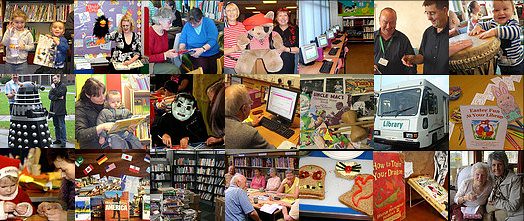
    Photos are good. A picture tells a thousand words. Summed up as "libraries do neat stuff."

    piles of good stuff going on in the library

    We need to make sure that people bump into photos of people enjoying themselves in the library. And keep bumping into pictures of people enjoying themselves in the library in odd places that might not be "library" places. Picture of people enjoying themselves in the library? Perhaps the library is an enjoyable place to visit? Perhaps they'll come and visit the library to see what other neat stuff we do.

    And we'll tell them.

    And we'll tell them to tell their friends.

    And we'll tell them about the neat stuff going on in our other libraries. And they can tell their friends that, too.

    The important, the most important, thing is that we cannot assume that people will know what we do. And we cannot afford for the off-chance that they pop in to find out. There is no place for assumption and blind hope in a time of uncertainty. We need to tell people what we do. And keep on telling them.

    If we wait to be asked they might not come and ask us. And they might just assume that we just stand around waiting to stamp out a few books, in between going "shhh!!!"

    Friday, 16 July 2010

    Listening to global voices

    Food for thought in one of the TED lectures. In this one, Ethan Zuckerman talks about the need to open up your online world and read the news in languages you don't even know.

    He argues that "the web connects the globe, but most of us end up hearing mainly from people just like ourselves." Which is uncomfortably like the problem with some public libraries — "for people like us, by people like us," with everybody else fringed off and assigned their special label to be treated differently. We know that this doesn't have to be so, and there's a lot going on in our libraries to try and knock that sort of attitude on the head. Which is just as well as public libraries are excellently positioned to help foster Zuckerman's "xenophilia" and have excellent reasons for making an active effort to do it.

    • Public libraries are — or should be — important serendipity engines within the community. The key purpose of the library is to give the user the keys to the world. This can't be effected if the library only delivers what the specifics that customer asks for. As Arkwright says: "What they come in for is up to themselves. What they go out with is up to us."
    • The survival of any public sector service is dependent on not just being important to "people like us." The more "people not like us" that a service engages with, satisfies and delights the better for its chances of survival. Which is why, for all the breast-beating over the years, the prospects for the public library service are better than those for the municipal blacksmith, the lamp-lighter and the knocker-upper.
    • Local economic recovery is dependent on entrepreneurship and inward investment. These days the key markets, and the money, are in Asia.
      • We need to maximise the chances of serendipitous discovery of opportunities for local entrepreneurs.
      • We need to maximise the chances of serendipitous discovery of local opportunities for overseas entrepreneurs.

    How to do it?

    • We need to make sure that we don't make all our user interface too relevant. At first that sounds counter-productive, we don't want to be wasting our customers' time after all. All I'm saying is that there always needs to be a small but visible proportion of almost randomised, but certainly unexpected, content or activity that can act as a bridge between the user's daily information/cultural commuting route and roads less-travelled. The whole customer experience needs to enable the same scope for serendipitous discovery as a browse of the library bookshelves.
    • We need to be open to and promote user-generated content that provides useful bridges. And perhaps even be brave enough to let customers themselves define and share "useful."
    • We need to mainstream and actively promote those activities that link us with "people unlike ourselves."
    • We need to make sure the we, our content and our community are available. If we're not there we won't be found. Back in the nineties a friend's library service scored quite a few Brownie points because a Japanese company used the library's online community information database to investigate the local social infrastructure, which led to them setting up a factory there.

    We should be doing that anyway. It's worth testing whether or not we actually do.

    Sunday, 23 May 2010

    Public library activity in the areas of health and well-being

    Reading Agency and Department of Information Science at Loughborough University have just issued a report — "Public library activity in the areas of health and well-being" — on a study funded by the MLA.

    There's a lot to feel encouraged about by this, not least the recognition that public libraries already do a lot of work with their local communities to promote both healthy living and well-being in general. As the authors state:
    "Libraries offer neutral, non- stigmatised, non-clinical community space, in a setting that differentiates it from hospital services, delivers the prevention agenda particularly effectively, and has implications for the audiences reached. Partners felt that the combination of these factors creates a unique offer that made the public library a good place to offer health and well-being activity."

    Inevitably, though, we continue to suffer because of the diffidence of the public library sector:

    "Libraries’ inability to articulate their contribution to the health and well-being agenda is reinforced by their relative invisibility in high level health, well-being and social care policy and strategy."

    This needs to change and it is encouraging to see that in many places it is changing and library managers are banging the drum about the contribution that their libraries make. It's important that we factor this into resource planning for public libraries. One of the continuing dangers of the development of self-service and 'tell us once' projects is that they are seen as replacements for front-line library staff instead of liberators of front-line library staff.
    "Library staff are viewed as a key resource in terms of their existing roles and functions, since some aspects of health and well-being work build on what library staff do and what they do well."

    If we can release front-line staff from purely mechanical tasks then they will have more time to do what they do so well. And it is arguably more cost-effective for the public purse to let (let's be honest: inexpensive) public library staff do their thing than it is to have a raft of projects and programmes, each with their own manager and funding stream.

    Wednesday, 7 April 2010

    Driving Change, Creating Experience & Moving Forward

    A very nice presentation on Michael Stephens' "Tame The Web" site. I particularly like the slides which show some unflinchingly unflattering perspectives of libraries from the customer's point of view. (It's been one of those months!) It's reassuring that I'm not entirely on my own in worrying about some of the bad habits of libraries.

    There are a lot of slides in this presentation, but that's OK, I promise you, because each one's quick and punchy and leads you swiftly on to the next. And the journey's worthwhile:
    • The strength of a library, particularly a public library, is its potential for being inclusive of a community and its being a trusted knowledge base within that community.
    • The survival of libraries depends on its active engagement with the community and, perhaps more crucially, the active engagement of a critical mass of individual customers and stakeholders.
    There are a lot of very easy, affordable, friendly and fun ways of turning the passive customer or potential customer into an active user and participant without losing sight of the core business of the libary. Quite a few are included here in a nicely-digestible form.